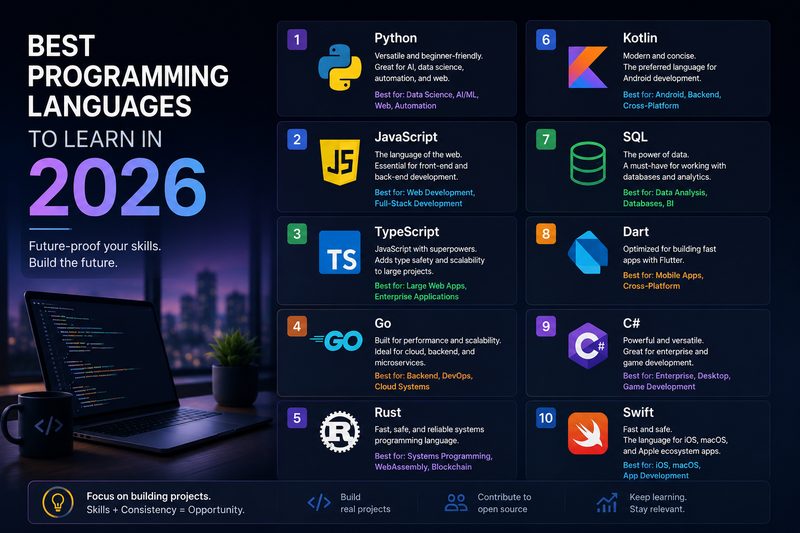
Choosing the right programming language to learn can shape your career, open new opportunities, and sharpen your problem-solving skills. As technology rapidly evolves, some languages gain momentum while others stabilize as industry standards. If you’re planning your learning roadmap for 2026, it’s essential to focus on languages that balance modern demand, versatility, and future-proofing your skillset.
Python: The All-Rounder for Growth and Innovation
Python continues to dominate as one of the most popular and beginner-friendly programming languages. Its clear syntax and broad library ecosystem make it a go-to for many domains — from web development with frameworks like Django and Flask, to data science, machine learning, automation, and even scientific computing.
For example, if you’re interested in AI or data-driven projects, Python’s TensorFlow and PyTorch libraries offer powerful tools for building neural networks. Beginners appreciate its readability, which makes coding less intimidating and more intuitive. Having Python on your resume signals versatility and a readiness to work on cutting-edge tech problems.
JavaScript: The Language of the Web
With the web evolving into sophisticated, interactive platforms, JavaScript remains indispensable. By 2026, JavaScript frameworks like React, Vue, and Angular will still be fueling frontend development. Additionally, Node.js continues to expand JavaScript’s role in backend programming.
Imagine building a real-time chat app or an e-commerce platform — you’ll almost certainly rely on JavaScript’s ecosystem. Its growing libraries and community support create endless possibilities for web developers. If you want to build websites or apps that connect millions of users, JavaScript is the language you must know.
Rust: Performance Meets Safety
Rust has been gaining traction for its unique ability to combine low-level control with memory safety without sacrificing performance. Unlike languages such as C or C++, Rust’s strict compiler checks prevent many common bugs before code even runs.
For example, companies working on systems software, embedded devices, and blockchain often turn to Rust to build secure, high-performance applications. If your goal is to work in critical software sectors where reliability is paramount – think finance, cybersecurity, or IoT – Rust offers a skill advantage that’s hard to overlook.
TypeScript: JavaScript with Superpowers
TypeScript, a statically typed superset of JavaScript, addresses many pitfalls of large-scale JavaScript apps by introducing type safety and better tooling. It’s particularly popular in enterprise environments where maintainability and scalability are key.
If you’re moving beyond basic web projects to complex applications, TypeScript helps catch errors early and improves developer productivity. Many modern frameworks now recommend or require TypeScript out of the box, so learning it alongside JavaScript is a smart way to future-proof your frontend and backend careers.
Go: Simple, Fast, and Scalable
Designed by Google, Go (or Golang) is praised for its simplicity, speed, and built-in support for concurrency. It’s an excellent choice if you want to build cloud-native applications, microservices, or network tools.
Picture creating a server that handles thousands of simultaneous user requests smoothly — Go’s goroutines make this straightforward. Its growing adoption in companies like Uber and Dropbox highlights its reliability in production. Plus, Go’s syntax is easy to pick up, especially if you have experience with C-style languages.
Swift: Powering Apple’s Ecosystem
If you’re interested in mobile development, Swift remains the top language for iOS, macOS, watchOS, and tvOS apps. Swift’s clean syntax and rapid development cycle help developers innovate quickly within Apple’s robust ecosystem.
By 2026, Swift’s continued evolution will likely make it even easier to craft rich user experiences on Apple devices. Whether you’re building your first iPhone game or a productivity app for the App Store, mastering Swift opens access to a lucrative and vibrant market.
Summary: Choose Based on Your Goals
The “best” programming language in 2026 depends heavily on what you want to achieve. For data science or AI, start with Python. For web and app development, JavaScript and TypeScript are essential. Rust and Go cater to performance and systems programming. Swift unlocks Apple-specific opportunities.
Think about where you want your career—or your personal projects—to lead. Pick a language aligned with those goals and dive in deeply. Staying adaptable and continuing to learn will keep you competitive in the fast-changing tech world.
Ready to invest in your future? Start learning one of these languages today, and watch how your skills open doors to exciting opportunities in 2026 and beyond.