

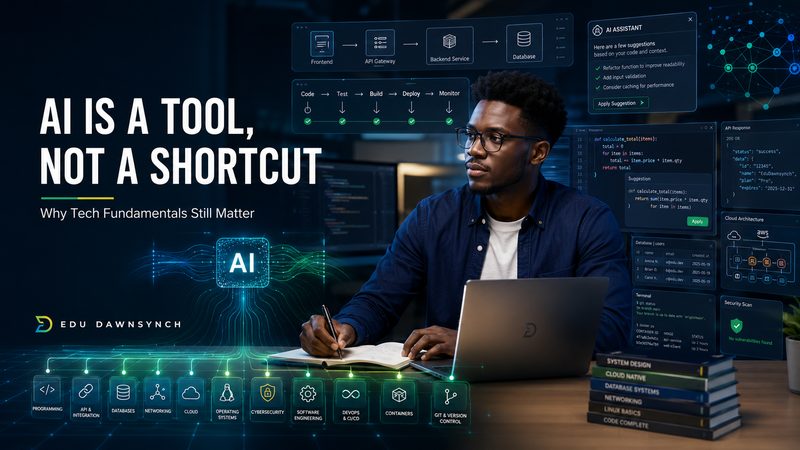
AI can now generate code, explain errors, design cloud architectures, write scripts, create documentation, and even help troubleshoot applications.
That is a major change in how we work.
It also raises a very reasonable question for anyone entering technology:
If AI can do so much, do I still need to spend time learning the fundamentals?
The short answer is yes.
AI can make a skilled technology professional much faster and more productive. But it does not remove the need to understand what you are building.
In many ways, technical knowledge becomes even more valuable when AI enters the picture.
The difference is that you no longer need to memorize everything. What matters more is understanding the concepts well enough to use AI intelligently.
AI Does Not Replace the Foundation
Think of technology fundamentals like the foundation of a building.
Modern tools can help you design the building faster. Machines can move materials faster. Software can calculate dimensions faster.
But none of that makes the foundation optional.
Technology works the same way.
A software developer still benefits from understanding programming, APIs, databases, networking, operating systems, security, cloud computing, software architecture, and how applications communicate.
AI may help generate the code that connects a system to a database. But when that connection fails, someone still needs to understand what could have gone wrong.
Was it the application?
The network?
The credentials?
The database?
A firewall?
A timeout?
AI can suggest possibilities, but your understanding helps you decide which suggestions actually make sense.
That is why strong technology fundamentals remain such an important part of becoming a technology professional.
AI Is a Tool, Not the Professional
Tools such as ChatGPT, Claude, Gemini, GitHub Copilot, and other AI coding assistants are extremely useful.
They can help you:
- Generate code
- Explain technical errors
- Write scripts
- Suggest architectures
- Generate tests
- Create documentation
- Write infrastructure configurations
- Explore different solutions
But there is an important distinction.
AI can produce an answer.
You are still responsible for deciding whether that answer is good.
You need to determine whether the proposed solution is secure, scalable, reliable, and appropriate for the problem you are solving.
Think about a calculator.
A calculator can perform mathematics much faster than most people can do manually.
But if you enter the wrong equation, it will still give you the wrong answer.
You need enough mathematical understanding to know what calculation should be performed.
AI works in a similar way.
It can accelerate your thinking and execution, but it doesn’t remove the need to understand the problem.
The Problem With Skipping the Basics
One of the biggest temptations today is to jump straight into building.
A beginner can ask an AI tool:
“Build me a full-stack application with login, payments, a database and cloud deployment.”
Within minutes, they may have something running.
That feels powerful.
The problem often appears later.
Maybe the API suddenly stops working.
The database becomes slow.
Authentication fails.
The application works locally but not after deployment.
Users cannot connect because of a networking problem.
Or an AI-generated piece of code contains a security weakness.
This is when the missing fundamentals become visible.
Many learners eventually discover that the shortcut takes them back to the basics they skipped.
That doesn’t mean beginners should avoid AI.
It means AI should support learning rather than replace it.
Don’t Build Systems You Cannot Explain
Suppose AI generates an architecture that looks like this:
Frontend → API Gateway → Backend Service → Database
That looks simple enough.
But understanding the diagram requires more knowledge than simply being able to reproduce it.
You should understand questions such as:
- What does the API Gateway actually do?
- How does the frontend communicate with the backend?
- What is an HTTP request?
- How does authentication work?
- How does the application connect to the database?
- What happens when the backend becomes unavailable?
- How are errors recorded?
- How is sensitive information protected?
- How would the system handle more users?
These are the questions that turn a generated architecture into a real engineering solution.
A useful rule is:
Never deploy something simply because AI generated it. Understand enough to explain why it works.
You don’t need to know every line from memory.
But you should be able to read it, question it, test it, modify it, secure it and troubleshoot it.
Your Fundamentals Actually Make AI Better
There is another important point that is sometimes overlooked.
Strong technical knowledge doesn’t compete with AI.
It makes AI more useful.
Consider these two prompts.
A beginner might ask:
“Create a cloud architecture for my application.”
Someone with more technical knowledge might ask:
“Design a highly available AWS architecture for a Spring Boot application running in containers, using PostgreSQL, private subnets, autoscaling, centralized logging and least-privilege IAM.”
The second prompt gives AI much more useful context.
Why?
Because the person asking the question understands the problem more deeply.
They know which requirements matter.
They know enough terminology to guide the conversation.
And when the AI responds, they are better positioned to challenge the answer.
This is one of the biggest advantages of learning technology fundamentals.
Your knowledge helps you:
- Ask better questions
- Give AI better context
- Detect incorrect suggestions
- Compare alternatives
- Troubleshoot faster
- Make better technical decisions
The quality of AI output is often limited by the quality of the person’s understanding of the problem.
AI Changes What You Need to Memorize
There is also good news.
Learning the fundamentals does not mean memorizing everything.
In the past, developers spent a lot of time remembering commands, syntax, library names and configuration formats.
AI reduces the need for that.
You don’t necessarily need to remember every Linux command, Docker command, SQL variation, Kubernetes configuration or cloud CLI option.
You can look those up or ask AI.
What matters more is understanding the underlying concept.
For example, you don’t need to memorize every command for creating a Docker container.
But you should understand what a container is, why teams use containers, how images work, how networking works and where application data should be stored.
That is the difference between:
Memorizing syntax
and
Understanding concepts
AI is becoming very good at helping with syntax.
Understanding remains your responsibility.
Two Junior Developers, Two Different Approaches
Imagine two junior developers starting their careers.
Developer A immediately uses AI to generate most of an application.
The application works, but they have not yet developed a good understanding of APIs, Git, databases, authentication, networking or deployment.
Everything looks fine until something breaks.
When the application fails after deployment, they struggle to identify where the problem is coming from.
Developer B also uses AI, but takes a slightly different approach.
They first build a reasonable understanding of programming, HTTP, APIs, Git, databases, Linux and basic cloud concepts.
They then use AI heavily to accelerate their work.
When something fails, Developer B can read logs, understand the architecture, question AI suggestions and narrow down the likely cause.
Both developers are using AI.
The difference is not whether they use it.
The difference is the knowledge they bring to the tool.
Over time, Developer B is likely to become more independent and capable of handling increasingly complex problems.
The Tech Fundamentals Worth Learning in the AI Era
You don’t need to become an expert in everything before you start building.
But there are several foundations worth developing.
Programming Fundamentals
Understand variables, data types, conditions, loops, functions, error handling, objects and basic data structures.
These concepts help you understand what code is actually doing, regardless of the programming language.
Web Fundamentals
Learn how browsers, servers, HTTP, REST APIs, DNS and authentication work.
Most modern applications depend heavily on these concepts.
Database Fundamentals
Understand tables, relationships, SQL, indexes and transactions.
AI can write database queries, but you still need to understand how data should be structured and why a query may perform poorly.
Networking Fundamentals
Learn about IP addresses, ports, DNS, routing and firewalls.
Networking knowledge becomes especially valuable when applications work in one environment but fail in another.
Operating Systems
Basic Linux knowledge is still extremely useful.
Understand files, permissions, processes, services and how applications run on a server.
Cloud Fundamentals
Learn the basics of compute, storage, networking, identity, scalability and high availability.
Cloud platforms change, but these core ideas remain fairly consistent.
Software Engineering
Understand Git, testing, debugging, software design and CI/CD.
These practices help teams build reliable software rather than simply producing code.
Security Fundamentals
Understand authentication, authorization, encryption, secrets management and common application vulnerabilities.
AI can generate working code that is still insecure. Security knowledge helps you recognize those risks.
A Better Way to Learn Technology With AI
The answer is not to reject AI.
Use it deliberately.
A practical approach is:
Step 1: Learn the Concept
Start by understanding what a technology does and why it exists.
If you are learning APIs, understand what an API is before asking AI to generate one.
Step 2: Practice Manually
Build something small yourself.
It doesn’t need to be impressive.
The goal is to see how the pieces fit together.
Step 3: Bring in AI
Ask AI to review your code, explain errors, suggest improvements or show you a different approach.
Now AI becomes a tutor as well as a productivity tool.
Step 4: Question the Answer
Don’t stop at the first response.
Ask:
- Why is this solution recommended?
- What alternatives exist?
- What are the risks?
- What happens if this component fails?
- Is there a simpler approach?
This is where real learning happens.
Step 5: Build Real Projects
Projects expose the gaps that tutorials often hide.
Build something that uses a database, an API, authentication or cloud deployment.
When things break, investigate.
That experience becomes part of your technical foundation.
The Real Advantage in the AI Era
The strongest technology professionals will not be the people who avoid AI.
And they will not necessarily be the people who use AI the most.
The advantage will come from combining three things:
Technical Fundamentals
+
Practical Experience
+
AI Skills
=
High-Impact Technology Professional
Someone who understands APIs, databases, cloud computing and software architecture can use AI to generate boilerplate code, write tests, review code, troubleshoot issues, create documentation and explore different designs much faster.
That person is not being replaced by AI.
They are being amplified by it.
This is especially important for students, self-taught developers, bootcamp graduates and professionals building technology careers in Kenya and across Africa.
There has never been a better time to learn.
You have access to documentation, online courses, open-source projects and AI tutors that can explain difficult concepts almost instantly.
Use those tools.
But don’t let convenience prevent you from understanding the craft.
Final Thought
The goal in the AI era is not to become the person who remembers every command.
It is to become the person who understands the problem well enough to direct the tools.
Learn the fundamentals.
Use AI to accelerate your learning and your work.
Build real things.
Break them.
Fix them.
And keep improving.
At Edu Dawnsynch, we believe the future belongs to professionals who can combine strong technical foundations with practical experience and intelligent use of AI.
AI is a powerful tool.
But understanding is still your advantage.
Suggested Featured Snippet
Do I still need to learn programming and technology fundamentals if I use AI?
Yes. AI can generate code and suggest solutions, but technology fundamentals help you understand, verify, troubleshoot and secure what AI produces. The best approach is to learn core concepts while using AI as a learning and productivity tool.
Frequently Asked Questions
1. Do I still need to learn coding because of AI?
Yes. AI can help write code, but coding knowledge helps you understand what the code does, identify errors, improve solutions and troubleshoot problems when something goes wrong.
2. What technology fundamentals should beginners learn?
Start with programming, Git, HTTP, APIs, databases, basic networking, Linux, cloud concepts, security and software development practices.
3. Will AI replace software developers?
AI is more likely to change how developers work than remove the need for developers altogether. Professionals who combine strong technical skills with effective AI use will be better positioned to handle complex work.
4. How should beginners use AI while learning programming?
Use AI to explain concepts, review your code, troubleshoot errors and suggest alternatives. Avoid asking it to build everything for you before you understand the basic concepts involved.
5. What technical skills will remain important in the AI era?
Problem-solving, programming fundamentals, system design, databases, networking, security, cloud computing, debugging and the ability to evaluate technical trade-offs will remain highly valuable.