

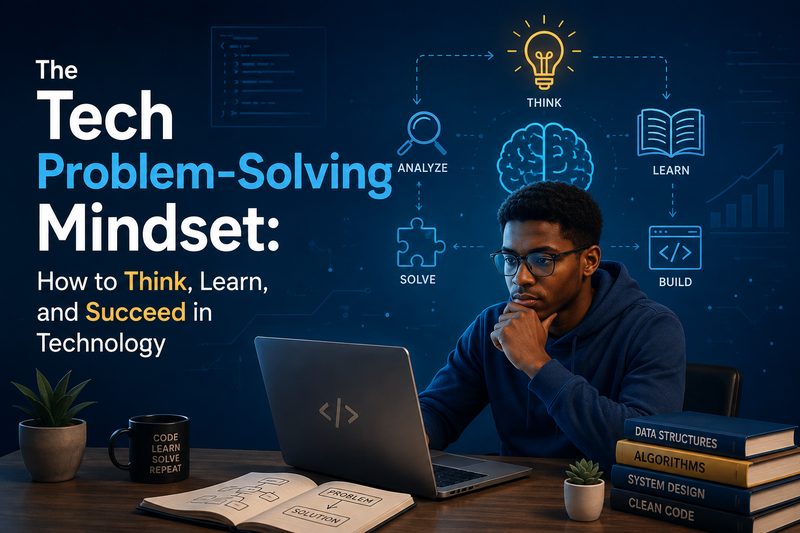
Imagine you are learning programming for the first time.
You write a few lines of code, press run, and suddenly your screen fills with an error message.
Your first reaction might be frustration.
You copy the error, search Google, find a solution on Stack Overflow or ask an AI assistant, paste the suggested code, and the application starts working again.
Problem solved, right?
Not necessarily.
A better question is: Do you understand what went wrong?
Someone developing a strong problem-solving mindset in tech approaches the same situation differently. They might ask:
- What exactly is failing?
- What changed since the last time it worked?
- What does the error message actually mean?
- Can I reproduce the problem?
- Can I isolate the part of the code causing the issue?
- What can I learn from this?
That difference in thinking is more important than it may appear.
Technology careers are not built around knowing every command, programming language, cloud service or tool. The industry changes too quickly for that.
What matters more is learning how to approach problems you have never seen before.
That is one of the most valuable skills you can develop as you enter tech.
What Does a Tech Mindset Really Mean?
There is no special personality required to work in technology.
You do not have to be a mathematics genius. You do not need to know how computers work from childhood. You also do not need to memorize thousands of commands.
A successful tech mindset is built around habits such as curiosity, logical thinking, patience, experimentation and continuous learning.
More importantly, it includes becoming comfortable with saying:
“I don’t know yet.”
The word yet matters.
Even experienced developers, cloud engineers, cybersecurity professionals and architects regularly encounter technologies or problems they have never seen before.
Their advantage is not that they already know everything.
Their advantage is that they have developed a process for finding out.
When they encounter something unfamiliar, they know how to investigate it, ask the right questions, test possibilities and gradually move closer to an answer.
That is the mindset needed for a career in technology.
Why Problem Solving Matters More Than Memorising Technology
Technology changes constantly.
A programming framework that everyone is talking about today may become less popular a few years from now.
Cloud platforms such as AWS and Azure release new services regularly.
Artificial intelligence tools are evolving even faster.
Programming languages improve. Security practices change. New platforms appear. Old platforms are retired.
Trying to memorise everything is therefore impossible.
Instead, think about how a good mechanic works.
A mechanic does not become good because they memorised every possible problem that every vehicle could ever experience.
They understand how the different parts of a vehicle work together.
When a car refuses to start, they begin investigating.
Is there fuel?
Is the battery working?
Is electricity reaching the starter?
Is the engine receiving fuel?
They narrow down the possible causes until they identify the problem.
Technology troubleshooting works in much the same way.
The tools may be different, but the thinking process is similar.
The Problem-Solving Mindset in Tech: A Simple Framework
A useful framework to remember is:
UNDERSTAND → BREAK DOWN → INVESTIGATE → TEST → LEARN → IMPROVE
You can use this process in software development, cloud computing, cybersecurity, networking, artificial intelligence and almost every other technology field.
1. Understand the Problem
One of the most common mistakes beginners make is trying to fix something before clearly understanding what is wrong.
Suppose someone tells you:
“The website is not working.”
That description is too broad.
A better starting point would be asking:
- What should be happening?
- What is actually happening?
- Is everyone affected or only some users?
- When did the problem begin?
- Was anything changed recently?
- Is there an error message?
Understanding the problem reduces guesswork.
2. Break the Problem Down
Large technology problems often become much easier once you divide them into smaller pieces.
Instead of thinking:
“The website is broken.”
You might investigate:
- Can users reach the website?
- Is the application running?
- Is the database available?
- Is the network connection working?
- Is login authentication failing?
- Was there a recent software deployment?
- Are there errors in the logs?
Each question removes possibilities.
This is one of the foundations of critical thinking in technology.
3. Investigate
Once you understand the problem, start collecting evidence.
That might include:
- Error messages
- Application logs
- Monitoring dashboards
- Documentation
- Recent configuration changes
- Previous incidents
- Google searches
- Stack Overflow discussions
- Vendor documentation
- AI assistants
Using these resources is not cheating.
Experienced technology professionals use them every day.
The real skill is learning what to search for, which information matters, whether a source can be trusted and why a suggested solution works.
4. Test
Now test your theory.
Where possible, change one thing at a time.
If you change five settings at once and the problem disappears, you may not know which change actually fixed it.
Testing carefully helps you understand cause and effect.
It also prevents you from accidentally creating additional problems.
5. Learn
Once the issue is solved, do not immediately move on.
Ask:
Why did that solution work?
This is where real learning happens.
The next time you encounter something similar, you will not simply remember the command you typed. You will understand the idea behind the solution.
6. Improve
The final step is often forgotten.
Ask whether the same problem can be prevented in future.
Could you:
- Add monitoring?
- Automate a manual process?
- Improve testing?
- Document the solution?
- Change the design?
- Create an alert?
- Improve security controls?
This is how problem solving gradually turns into engineering.
What Problem Solving Looks Like in Real Tech Jobs
The same thinking process appears across many technology careers.
Software Development
Imagine a developer changes some code and suddenly the application begins returning an error.
Instead of rewriting the whole application, they examine the error message.
They identify which function is failing.
They reproduce the issue.
They test that function separately.
They eventually identify the mistake and correct it.
That is problem solving in software development.
Cloud and DevOps
Imagine an application running on AWS suddenly cannot connect to a database.
A beginner might immediately conclude:
“AWS is not working.”
An experienced engineer investigates systematically.
Is DNS resolving correctly?
Are network routes correct?
Are the security groups allowing the right traffic?
Is the database running?
Are the credentials correct?
Is the application using the right configuration?
Each question narrows down the possible cause.
Cybersecurity
Suppose a security analyst sees unusual login attempts against several accounts.
They should not immediately assume there is a successful cyberattack.
They investigate.
Where are the attempts coming from?
Which accounts are being targeted?
What time did they occur?
Were the login attempts successful?
Is multi-factor authentication enabled?
Do other logs show suspicious activity?
The analyst collects evidence before making a conclusion.
Artificial Intelligence
Imagine a company builds an AI assistant that sometimes produces poor answers.
The immediate reaction might be:
“We need a better AI model.”
But the model may not actually be the problem.
The engineer might investigate:
- Is the source data accurate?
- Are the right documents being retrieved?
- Is the prompt clear?
- Are the model settings appropriate?
- Is the system receiving enough context?
Again, the technology is different, but the mindset is the same.
Stop Being Afraid of Errors
Many beginners interpret error messages personally.
They see an error and think:
“Maybe I am not good at technology.”
But errors are normal.
Experienced engineers encounter errors every day.
An error message is often simply the computer giving you information about what happened.
Think of it like a warning light in a car.
The warning light does not mean you are a bad driver.
It means something needs investigation.
The same applies in technology.
In technology, the goal is not to avoid problems. The goal is to become better at solving them.
The more problems you troubleshoot, the more confident you become.
Learn to Ask Better Questions
Strong technology professionals do not only know how to answer questions.
They know how to ask good ones.
Compare these two examples.
Weak question:
“My application is not working. What should I do?”
Better question:
“My application was working before yesterday’s deployment. It now returns an HTTP 500 error when connecting to the database. The database itself is reachable, and the credentials have not changed. What should I investigate next?”
The second question gives useful information.
It demonstrates that the person has already started investigating.
Learning how to ask better questions also makes tools such as Google and AI assistants much more useful.
Become Comfortable With Not Knowing
Nobody knows everything in technology.
Not developers.
Not architects.
Not cybersecurity specialists.
Not cloud engineers.
The technology industry is simply too large.
Instead of thinking:
“I don’t know how to do this.”
Train yourself to think:
“I don’t know how to do this yet. What do I need to learn to solve it?”
That small change in thinking can completely change how you approach difficult situations.
It turns uncertainty into a learning problem.
Stay Curious — Even After Something Works
Curiosity is one of the most underrated technology skills for beginners.
Do not always stop at:
“It works.”
Ask another question.
Why does it work?
What is happening behind the scenes?
What would make it fail?
Could I solve the same problem another way?
What happens if 100 users become 100,000 users?
Could part of this process be automated?
These questions slowly build deeper understanding.
Over time, you stop simply using technology and start understanding how systems behave.
Build Projects, Not Just Knowledge
Problem-solving skills cannot be developed through reading alone.
You have to build things.
Your first project does not need to be impressive.
Build a personal website.
Create a simple Python script.
Deploy a small application to the cloud.
Create a simple API.
Dockerise an application.
Build a basic chatbot.
Create a home lab.
Build a small data dashboard.
The most important part of the project may actually be the problems you encounter while building it.
Something will fail.
A configuration will be wrong.
A dependency will refuse to install.
Your application may work locally but fail when deployed.
Those frustrating moments are where much of the learning happens.
Escape Tutorial Hell
Many people learning technology fall into what is often called tutorial hell.
They complete course after course but still feel unable to build anything without instructions.
A better learning pattern is:
Learn → Follow → Modify → Break → Fix → Build independently
Start with a tutorial.
Follow it.
Then change something.
Add another feature.
Change the database.
Deploy the application somewhere else.
Modify the user interface.
Break something.
Then figure out how to fix it.
This is uncomfortable at first.
But that discomfort develops genuine confidence.
You begin learning how to think like a developer or engineer rather than simply following instructions.
Document What You Learn
One simple habit can dramatically improve your learning: document the problems you solve.
Record things such as:
- The problem
- The error message
- What caused it
- What you investigated
- Commands you used
- The final solution
- What you learned
You can keep these notes in a notebook, GitHub repository, personal knowledge base or blog.
Months later, you may encounter the same problem again.
More importantly, documenting your thinking teaches you how to explain technical problems clearly.
That becomes extremely valuable as your career grows.
Problem Solving Is Ultimately What Companies Pay For
Technology companies do not hire people simply because they know tools.
They hire people because there are problems that need solving.
A developer solves problems using software.
A cloud engineer solves infrastructure, availability and scalability problems.
A cybersecurity analyst solves security problems.
A data analyst helps organisations understand information and make better decisions.
An AI engineer uses artificial intelligence to solve business problems.
An enterprise architect helps organisations understand complex business and technology challenges and design better solutions.
The tools matter.
Certifications matter.
Programming languages matter.
But they are ultimately tools for solving problems.
That is why developing strong problem-solving skills in technology can become one of your biggest career advantages.
A 30-Day Problem-Solving Challenge
If you are beginning your technology journey, try this simple challenge.
Every week for the next month:
- Choose one small technology problem.
- Try understanding it before searching for the answer.
- Write down what you already know.
- Break the problem into smaller questions.
- Research possible causes.
- Test your ideas.
- Solve the problem.
- Document what you learned.
Start small.
As your confidence improves, choose more difficult problems.
After several months, you may notice something important.
Problems that once made you panic will start making you curious.
That is progress.
Your Most Valuable Technology Skill May Be How You Think
If you are trying to start a career in tech, it is easy to become overwhelmed.
Which programming language should you learn?
Should you choose AWS or Azure?
Should you study cybersecurity, cloud computing, software development, DevOps, data or AI?
Should you get another certification?
These are useful questions.
But there is another question that may be even more important:
Am I learning how to solve problems?
The people who succeed in technology are not always the people who knew the most when they started.
They are often the people who learned how to investigate, experiment, ask questions, adapt, persist and keep learning.
Technology will keep changing.
The tools you learn today may look very different five years from now.
But if you learn how to understand problems, break them down, investigate them, test possible solutions and keep learning, you will develop a skill that remains valuable throughout your entire technology career.