

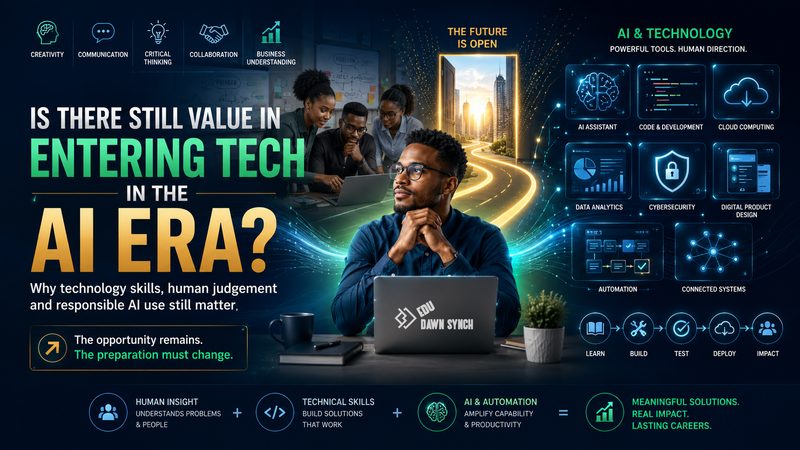
A question I hear more often today is this: Is it still worth entering technology when artificial intelligence can already write code, design websites, analyse data and automate work?
It is a fair question.
Anyone considering a career in technology can see that the field is changing quickly. Tasks that once required hours of manual work can now be completed in minutes. AI tools can generate software code, create images, summarise reports, suggest system designs and help people solve technical problems.
This can make it seem as though technology careers are disappearing before some people have even had the chance to enter them.
But that is not the full picture.
Technology is still one of the most valuable fields to enter. What has changed is how you need to prepare, learn and position yourself.
The old approach was often straightforward: learn a programming language, earn a certificate, apply for a junior role and slowly build experience.
That route can still work, but it is no longer enough on its own.
In the AI era, the most valuable technology professionals will not simply be people who know how to use tools. They will be people who understand problems, know how technology works, use AI responsibly and can turn ideas into useful solutions.
AI has not made technology knowledge irrelevant. It has made shallow knowledge less valuable and practical understanding more important.
Is There Still Value in Entering Tech?
Yes, there is still significant value in entering tech.
Almost every modern organisation depends on technology to operate.
Banks depend on digital platforms to process payments, manage accounts, detect fraud and serve customers. Hospitals use systems to manage patient records, appointments and medical information. Farmers use technology to access markets, track produce, monitor weather and manage supply chains.
Schools use online learning platforms. Logistics companies rely on tracking systems. Retailers use e-commerce, payment systems and sales data. Governments depend on digital services to provide public information and serve citizens.
Even businesses that do not consider themselves technology companies rely on:
- Software applications
- Websites and mobile apps
- Data and reporting
- Cybersecurity
- Cloud platforms
- Digital payments
- Automation
- Communication tools
- Reliable computer networks
Technology is not becoming less important. It is becoming more deeply connected to how organisations operate.
What is changing is the nature of the work.
Some routine tasks are becoming easier to automate. A developer may no longer need to write every line of basic code manually. A data analyst may use AI to clean or interpret information. A designer may use AI to create initial concepts.
However, these tools still need people who can decide what should be built, whether the output is correct and whether the solution is safe, useful and appropriate.
This is similar to how calculators changed mathematics.
Calculators made arithmetic faster, but they did not remove the need to understand numbers. In fact, a person who does not understand mathematics cannot easily tell when a calculator has been used incorrectly.
AI is doing something similar to technology work. It is reducing the effort required for some tasks, but it is not removing the need for understanding.
Entering tech is still valuable, but entering with only surface-level skills is becoming riskier.
Knowing how to copy code from an AI tool is not the same as knowing how to build a secure and reliable system. Knowing how to generate a dashboard is not the same as knowing which information matters to a business.
The real opportunity lies in combining technical knowledge with judgement, problem-solving and an understanding of people and organisations.
How Technology Gives You an Edge and Leverage
Technology gives people leverage.
Leverage simply means using a tool, skill or system to achieve more than would be possible through manual effort alone.
Imagine a shop owner who records every sale in a notebook. At the end of the week, the owner must count everything manually to understand which products sold well.
Now imagine the same owner using a simple digital stock and sales system. The system can automatically calculate totals, identify popular products and show when stock is running low.
The shop owner has not just saved time. The owner can now make better decisions.
That is the power of technology.
A person with technology skills can:
- Build a digital product
- Automate repetitive work
- Analyse information
- Improve a business process
- Reach customers online
- Work with people in different countries
- Build tools that serve many users
- Start a business with a small team
- Use AI more effectively
One person can create a website that serves thousands of visitors. A small team can build an online service that reaches users across several countries.
A developer can create a mobile app once and make it available to many customers. A data analyst can design a report that helps an entire organisation make better decisions. An automation specialist can create a workflow that saves hundreds of hours every month.
This is why technology remains a powerful career and business advantage.
Technology helps you create once and serve many
Consider a person who offers training in person. Without technology, that trainer may only teach the number of people who can fit into a room.
By creating an online course, the trainer can teach hundreds or thousands of learners without repeating every lesson individually.
The same principle applies to software.
A budgeting application can help many households. A farm produce tracking system can support many farmers. A customer enquiry chatbot can answer common questions throughout the day.
Technology allows useful work to be repeated at a lower cost.
Technology helps small teams achieve more
In the past, building a business often required a large number of employees from the beginning.
Today, a small team can use digital platforms, cloud services, automation and AI tools to handle marketing, customer support, payments, reporting and operations.
This does not mean people are no longer needed. It means people can focus more on decisions, relationships and complex work while technology handles repetitive tasks.
Technology improves how you use AI
Someone who understands technology can usually get more value from AI than someone who does not.
For example, AI may generate code for a website. However, a person with technical knowledge can check whether the code is secure, efficient and suitable for the intended users.
AI may suggest how to connect two systems. A technology professional can assess whether the integration will be reliable and protect customer information.
AI may create an impressive answer, but knowledge helps you recognise whether that answer is incomplete or wrong.
Technology knowledge gives you the ability to direct AI rather than depend on it blindly.
Why Tech Is Still Relevant in the AI Era
AI can produce impressive outputs, but real-world technology work involves much more than generating an output.
A useful system must solve the right problem. It must work with existing processes. It must protect information. It must be affordable, reliable and easy to maintain.
AI does not automatically understand all these conditions.
Someone must define the right problem
Many technology projects fail because teams solve the wrong problem.
A business may ask for a mobile app when the real issue is a slow internal approval process. A school may request a new platform when the actual problem is that teachers have not been trained to use the existing one.
Technology professionals must ask questions such as:
- Who is experiencing the problem?
- What is causing it?
- What outcome is required?
- What constraints exist?
- How will success be measured?
AI can help explore possible answers, but people still need to understand the situation.
Someone must understand users
A system may work technically and still fail because people find it confusing or inconvenient.
Users have different needs, habits and levels of digital confidence. A solution designed for an urban bank customer may not work equally well for a farmer in an area with unreliable internet.
Technology professionals need empathy. They must understand how people will use a product in real situations.
Someone must design the system
AI can suggest components, but building a dependable system requires decisions.
Where will information be stored? How will users sign in? What happens if a service becomes unavailable? How will the system recover from failure? How will it support more users in future?
These decisions require technical knowledge and an understanding of business priorities.
Someone must manage and protect data
AI systems depend heavily on data.
That data may include customer details, financial records, health information or confidential business information.
Technology professionals must decide:
- What information should be collected
- Where it should be stored
- Who should access it
- How long it should be kept
- How it should be protected
- Whether it is accurate enough for the intended purpose
Poor data can lead to poor decisions, no matter how advanced the AI system appears.
Someone must review AI-generated work
AI can make mistakes confidently.
It may create code that works in a simple test but fails under real usage. It may suggest outdated software. It may generate insecure configurations or misunderstand the actual requirement.
AI-generated work must be tested and reviewed.
The better your technical foundation, the better you can judge whether the output is correct.
Someone must integrate systems
Most organisations do not operate using one system.
A bank may have separate systems for customer accounts, mobile banking, payments, fraud detection and reporting. A retailer may use different platforms for sales, stock, suppliers and online orders.
These systems must exchange information reliably.
Integration work requires knowledge of data, security, processes and failure handling. AI can assist with parts of the work, but it does not remove the need for careful design.
Someone must manage risk and responsibility
Technology decisions can affect people’s money, privacy, access to services and safety.
If an AI system rejects a loan application, someone must understand why. If a digital platform exposes customer information, someone must take responsibility for the design and controls.
Responsible technology requires human oversight.
The most valuable professionals will therefore combine:
- Technical skills
- Business understanding
- Communication
- Creativity
- Critical thinking
- Ethical judgement
- AI literacy
The future of tech belongs less to people who only know tools and more to people who understand how to apply tools wisely.
Common Myths About Tech Careers in the AI Era
Many people are discouraged from entering technology because of assumptions that are only partly true.
Let us look at some of the most common myths.
Myth 1: AI Will Replace All Technology Jobs
AI will replace some tasks. It may also reduce the number of people required for certain types of routine work.
That should not be ignored.
Basic coding, simple design work, routine documentation and repetitive analysis are becoming easier to automate.
However, a job is usually made up of many different tasks.
A software developer does more than type code. Developers clarify requirements, investigate problems, make design decisions, test systems, review security risks and work with other teams.
A business analyst does more than write documents. Analysts understand processes, identify gaps, manage expectations and help teams agree on what should change.
AI will reshape these roles, but it will not remove every responsibility within them.
New responsibilities are also emerging in areas such as:
- AI governance
- AI system integration
- Data preparation
- AI security
- Model monitoring
- Automation design
- AI risk management
- Human review of AI decisions
The more realistic view is that AI will change technology jobs, not simply erase them all.
Myth 2: There Is No Need to Learn Coding Because AI Can Code
AI can generate code, but generated code still needs to be understood.
Suppose an AI tool creates a payment application. The application appears to work, but it accidentally allows the same payment to be processed twice.
A person who does not understand software logic may not notice the problem until customers lose money.
Coding is not only about memorising commands. It teaches you how to think through instructions, conditions, data and system behaviour.
You still need to understand:
- Programming logic
- How software is structured
- How information moves through a system
- How to test code
- How to identify security problems
- How to improve performance
- How to maintain a solution
AI can help you code faster. It cannot take responsibility for code you do not understand.
A strong approach is to learn coding while using AI as a learning partner. Ask it to explain concepts, review your work and suggest alternatives, but do not depend on it to think for you.
Myth 3: Only AI Engineers Will Have Valuable Careers
AI engineering is an important field, but it is not the only technology path with value.
AI systems still depend on other areas of technology.
Cybersecurity professionals protect systems and data. Cloud engineers provide the infrastructure on which applications run. Network specialists keep systems connected. Software engineers build and maintain digital products.
Business analysts help organisations understand what should be built. Product managers coordinate priorities. User experience designers make systems easier to use. Technical support professionals help users solve problems.
Other valuable paths include:
- Software development
- Data analysis
- Cybersecurity
- Cloud computing
- DevOps
- Networking
- Product management
- Business analysis
- User experience design
- Enterprise architecture
- Technical support
- Digital operations
- Quality assurance
AI will influence many of these careers, but it will not make them unnecessary.
Myth 4: You Must Be Exceptionally Gifted in Mathematics
Some technology roles require strong mathematics.
Advanced data science, machine learning, graphics and certain engineering areas can involve significant mathematical knowledge.
However, many technology careers do not require advanced mathematics every day.
Software development often relies more heavily on logic, problem-solving and careful thinking. Business analysis requires communication and process understanding. User experience design involves research, creativity and empathy.
Technical support requires patience and troubleshooting ability. Cloud and infrastructure roles involve systems thinking, networking and automation.
You do not need to be a mathematical genius to enter technology.
Curiosity, consistency and practice matter greatly.
Myth 5: A Certificate Guarantees Employment
Certificates can be useful.
They provide structure, introduce important concepts and show that you have invested in learning.
However, a certificate does not automatically prove that you can solve a real problem.
Many learners complete course after course but have little practical work to show.
Employers increasingly want evidence that you can apply what you know.
This may include:
- A working application
- A data dashboard
- A case study
- A cloud deployment
- A cybersecurity assessment
- A business process improvement
- A portfolio website
- A documented automation workflow
A certificate may help you get attention. Practical ability helps you earn trust.
Myth 6: It Is Too Late to Enter Tech
Technology is not limited to people who started coding as children.
Students can enter tech. Graduates can enter tech. Professionals from finance, teaching, marketing, healthcare, agriculture or logistics can also move into technology roles.
In fact, experience from another industry can become an advantage.
A nurse who learns technology may understand healthcare problems better than a developer who has never worked in a hospital.
An accountant who learns data analysis may be better positioned to create useful financial reports. A logistics professional who learns automation may identify opportunities that a general technology professional would miss.
The goal is not always to abandon what you already know. It may be to combine your existing knowledge with technology.
Myth 7: Learning One Programming Language Is Enough
Programming languages are tools.
Tools change over time.
A person who builds an entire career around one language without understanding broader principles may struggle when the market changes.
The more durable skills include:
- Problem-solving
- System design
- Data understanding
- Testing
- Security
- Communication
- Learning new tools
- Understanding users
- Understanding business needs
Languages and platforms matter, but they should not become your entire professional identity.
Instead of saying, “I am only a Java developer,” it may be more useful to say, “I build secure digital services that help financial organisations process transactions reliably.”
The second description focuses on the value you create.
How to Break Into Tech in the AI Era
Breaking into technology is still possible, but it requires a more deliberate approach.
Step 1: Choose a Problem Area, Not Just a Trend
Many learners begin by asking, “Which technology is popular?”
A better question is, “Which type of problem do I want to solve?”
You may be interested in:
- Finance
- Agriculture
- Education
- Healthcare
- Logistics
- Retail
- Marketing
- Government services
- Small-business operations
This helps you build useful knowledge around a real area.
For example, someone interested in agriculture might build a produce tracking system. Someone interested in education could create an attendance dashboard. Someone interested in finance could develop a budgeting tool.
The technology becomes more meaningful when it is connected to a problem.
Step 2: Select a Practical Technology Path
Technology is a wide field. You do not need to learn everything at once.
Software development
Software developers create websites, mobile applications and business systems.
This path suits people who enjoy building, solving logical problems and turning ideas into working products.
Data analysis
Data analysts help organisations understand information and make better decisions.
They work with spreadsheets, databases, visual reports and statistics.
Cybersecurity
Cybersecurity professionals protect systems, networks and information from misuse, loss and attack.
This path suits people who enjoy investigation, risk analysis and understanding how systems can fail.
Cloud and DevOps
Cloud professionals help organisations run applications on shared computing platforms. DevOps focuses on making software development and deployment faster, safer and more reliable.
These roles involve infrastructure, automation and system reliability.
Networking
Networking professionals connect systems, devices and locations.
They help ensure that information can move reliably and securely.
Product management
Product managers help teams decide what to build, why it matters and which features should come first.
The role combines business understanding, user needs and technology knowledge.
Business analysis
Business analysts examine how organisations work and help define improvements.
They connect business teams with technology teams.
User experience design
User experience designers make digital products easier and more enjoyable to use.
They study users, design layouts and test how people interact with systems.
Technical support
Technical support professionals help users solve technology problems.
This can be a strong entry point because it builds troubleshooting, communication and system knowledge.
Artificial intelligence and automation
This path focuses on using AI and automation to improve work, decisions and services.
It may involve AI tools, workflow platforms, data and system integration.
Choose one starting path. You can expand later.
Step 3: Learn the Fundamentals
AI makes it tempting to skip the basics.
That is a mistake.
Fundamentals help you understand what AI is producing and why something works.
For software development, learn:
- Programming logic
- Databases
- APIs, which allow systems to exchange information
- Version control, which tracks changes to code
- Testing
- Security basics
For data analysis, learn:
- Spreadsheets
- SQL, which is used to retrieve data from databases
- Data cleaning
- Data visualisation
- Basic statistics
- How to interpret information
For cloud and infrastructure, learn:
- Operating systems
- Networking
- Security
- Automation
- Application deployment
- Monitoring
Do not aim to memorise everything. Aim to understand how the pieces connect.
Step 4: Learn to Work With AI
AI should become part of your learning process, but not a replacement for learning.
You can use AI as:
- A tutor
- A brainstorming partner
- A reviewer
- A coding assistant
- A research assistant
- A documentation helper
- A productivity tool
For example, after writing code, ask AI to explain possible weaknesses. After creating a system design, ask it to suggest failure scenarios. When learning a new concept, ask for a simple explanation and then verify it through practice.
At the same time, build good habits:
- Question the output
- Test recommendations
- Compare alternatives
- Protect confidential information
- Check for outdated advice
- Avoid submitting work you do not understand
- Be transparent when AI has been used
AI can help you learn faster, but only when you remain responsible for the result.
Step 5: Build Real Projects
Projects are one of the strongest ways to demonstrate ability.
Do not wait until you feel completely ready. Start with something small.
Examples include:
- A website for a local business
- A simple budgeting application
- A school attendance dashboard
- An automated weekly report
- A stock management tool
- A farm produce tracking system
- A customer enquiry chatbot
- A public-data dashboard
- A booking system for a small service business
A small project that works is more valuable than a large project that remains unfinished.
Your project does not have to be completely original. It needs to show that you can understand a problem and create a solution.
Step 6: Document Your Work
Do not only show the final product. Explain your thinking.
For each project, describe:
- The problem
- The intended users
- The solution
- The tools used
- The challenges encountered
- How AI was used
- What you tested
- What you would improve
This demonstrates more than technical skill. It shows how you think.
You can present your work through:
- GitHub
- A portfolio website
- Blog articles
- Short videos
- Case studies
- Presentations
A good portfolio does not need many projects. Three well-explained projects may be more useful than twenty unfinished ones.
Step 7: Gain Practical Experience
Experience does not only come from formal employment.
You can gain experience through:
- Internships
- Volunteer work
- Freelance assignments
- School projects
- Community projects
- Open-source contributions
- Personal businesses
- Helping a small organisation
- Supporting a family business
Suppose a local shop struggles to track stock. Building a simple stock dashboard gives you real experience.
Suppose a community organisation manually prepares the same report every month. Automating part of that process becomes a useful project.
Look for problems around you.
Step 8: Build Communication and Business Skills
Some technology professionals focus heavily on tools and ignore communication.
That limits their growth.
You need to learn how to:
- Ask clear questions
- Explain technical ideas simply
- Listen to users
- Present recommendations
- Understand costs
- Work with different teams
- Manage expectations
- Connect technology to business results
An organisation rarely invests in technology simply because it is interesting. It invests because the technology can reduce cost, improve service, manage risk, increase revenue or support growth.
The more clearly you can connect your work to those outcomes, the more valuable you become.
Step 9: Join Communities and Build Relationships
Skills matter, but people also need to know what you can do.
Join technology communities, attend events, take part in hackathons and contribute to professional discussions.
Share what you are learning. Ask thoughtful questions. Help other learners where you can.
Relationships can lead to:
- Mentorship
- Internships
- Project partnerships
- Job referrals
- Freelance work
- Learning opportunities
You do not need to pretend to be an expert. You can simply document your progress honestly.
Visibility should follow substance. Build first, then share what you have built and learned.
Step 10: Keep Learning Without Chasing Every Tool
New AI and technology tools appear constantly.
Trying to master all of them will leave you exhausted and distracted.
Build strong foundations, then learn tools based on the problems you need to solve.
When evaluating a new tool, ask:
- What problem does it solve?
- Is it better than what I already use?
- Is it secure?
- Is it affordable?
- Can it be maintained?
- Will it still be useful after the excitement fades?
You do not need to know every tool. You need to know how to learn and how to choose.
The Difficult Reality of Breaking Into Tech
It would be misleading to suggest that entering technology is easy.
Entry-level roles can be competitive. Employers may ask for experience even from junior applicants. AI is also reducing the amount of simple work that was previously given to beginners.
That creates a real challenge.
In the past, a junior developer might have spent time writing basic code or producing simple documentation. AI can now perform some of those tasks.
This means beginners must develop useful judgement earlier.
You can respond by building:
- Deeper understanding
- Stronger projects
- Better communication
- Knowledge of a specific industry
- The ability to use AI responsibly
- Evidence that you can complete practical work
Do not measure your progress only by the number of courses you have completed.
Many learners spend months collecting certificates but never build anything. Courses can help, but building exposes the gaps in your understanding.
There are three levels worth recognising:
- Learning how to use a tool
- Understanding how the technology works
- Knowing how to apply it to a valuable problem
The third level creates the strongest career advantage.
Anyone can ask an AI tool to build a website. Far fewer people can understand a struggling business, identify why customers are leaving and create a digital solution that improves the situation.
That difference matters.
Do Not Compete With AI at Routine Output
One of the biggest mistakes a learner can make is trying to compete with AI at tasks AI performs quickly.
You will not create career security by becoming the fastest person at producing basic code, generic reports or simple designs.
Instead, become the person who knows:
- What should be built
- Who it should serve
- Which risks matter
- How the parts should work together
- Whether the solution is correct
- How to improve it over time
AI makes it easier to produce average work.
That raises the importance of good judgement.
Many people can now create a basic website. Fewer can create one that is accessible, secure, easy to use and connected to a real business goal.
Many people can generate an application using AI. Fewer can maintain it when users increase, data becomes sensitive or systems start failing.
The goal is not to prove that you can work without AI.
The goal is to prove that you can use AI and technology to produce trustworthy results.
Human Skills Still Matter
Technology work has always involved people.
A system is created for someone. A project affects a team. A technical decision carries business consequences.
Human judgement, curiosity, responsibility, creativity and trust remain important.
Curiosity helps you investigate beyond the first answer.
Responsibility makes you consider the impact of your work.
Creativity helps you see solutions that are not obvious.
Communication helps people understand and support your ideas.
Trust is what makes an organisation comfortable giving you access to important systems and information.
These qualities are difficult to demonstrate through a certificate alone. They become visible through how you work, how you communicate and how you handle problems.
Final Thoughts
There is still value in entering tech in the AI era.
Technology continues to shape banking, healthcare, agriculture, education, logistics, retail, government and almost every other industry.
AI has not removed the need for people who can build systems, protect information, analyse data, understand users and solve practical problems.
However, the old formula is no longer enough.
Learning one tool, earning one certificate and expecting a permanent career advantage is not a reliable strategy.
The better path is to:
- Build strong foundations
- Understand real-world problems
- Select a practical area of focus
- Use AI as an assistant rather than a substitute for thinking
- Build and document useful projects
- Develop communication and business skills
- Keep learning without chasing every trend
Do not enter tech simply because it appears popular or well paid.
Enter because you want to understand how digital systems work and how they can be used to improve lives, businesses and communities.
The opportunity is still there. But the standard is changing.
AI has not closed the door to technology careers. It has changed what is required to walk through that door and remain valuable once you enter.